


As organizations move from experimenting with AI to operationalizing it across engineering teams, the focus increasingly shifts from individual AI features to the platform capabilities that make AI trusted, secure, and scalable.
With IBM Engineering AI Hub 1.3, generally available from June 18, 2026, we continue building that enterprise foundation. This release expands the platform with new capabilities for governed AI access to engineering data, broader deployment flexibility, greater openness in AI ecosystems, and enhanced support for customer-specific engineering processes.
Managed MCP endpoint for ELM: Governed AI-ready access to engineering data
Engineering AI Hub 1.3 introduces a managed Model Context Protocol (MCP) endpoint for IBM Engineering Lifecycle Management (ELM) data and Rhapsody Systems Engineering models.
One of the biggest challenges in enterprise AI is not building the AI itself, it is giving AI secure, governed access to the information it needs to produce meaningful results. Traditionally, every AI assistant or automation initiative has required teams to create and maintain their own custom integrations with enterprise systems. These integrations often duplicate effort, create inconsistent governance models, and become increasingly difficult to maintain over time.
Engineering AI Hub addresses this challenge through MCP Tools for ELM and Rhapsody SE.
Rather than treating engineering artifacts as isolated pieces of information, MCP Tools transform ELM data into trusted, lifecycle-aware context that can be consumed consistently through natural language interactions across AI assistants, copilots, agents, and orchestrated workflows.
This approach delivers several important advantages:
- Trusted engineering context. AI gains access not only to individual artifacts, but also to the relationships that connect DOORS Next requirements, work items in Engineering Workflow Management (EWM), tests in Engineering Test Management (ETM), models in Rhapsody SE, and other lifecycle data.
- Built-in governance. MCP Tools leverage existing ELM role-based permissions, access controls, and traceability, ensuring that AI interactions follow the same governance model that organizations already trust.
- Enterprise controls. As AI adoption grows, platform-level controls help maintain security, stability, and fair resource utilization across users and workflows.
- Reusable AI integration layer. Instead of rebuilding integrations for every new AI use case, organizations can build once and reuse the same governed foundation across multiple assistants and automations.
The managed MCP endpoint also enables four broad categories of AI-enabled interactions:
- Discover engineering artifacts and lifecycle context.
- Analyze engineering relationships to generate insights and recommendations.
- Act by creating or updating engineering artifacts through AI-assisted interactions.
- Automate multi-step engineering workflows using reusable AI skills and agents.
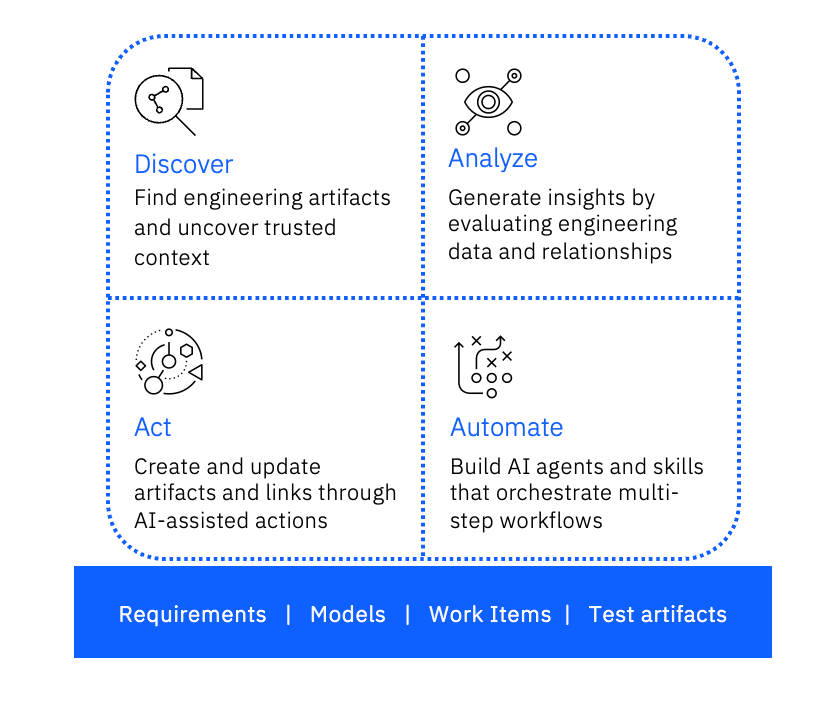
Importantly, MCP Tools are more than another API surface. They provide the mechanism that transforms engineering data into governed, AI-ready context, creating a scalable foundation for the next generation of engineering agents and agentic workflows.
For additional details, refer to Engineering AI Hub MCP Tools. You can also read our related articles to explore a handful of practical scenarios that illustrate what is possible across requirements, testing, planning, and development artifacts with the IBM Engineering AI Hub 1.3.
Beyond queries: AI-assisted Work Item Management with Engineering AI Hub 1.3 MCP Tools
AI-assisted Test Management with Engineering AI Hub 1.3 MCP Tools
A2A-compliant agent extensibility
Engineering AI Hub 1.3 also expands openness through A2A-compliant agent extensibility. Customers can now incorporate IBM-provided agents into their own orchestrated workflows and preferred agent frameworks, enabling AI-assisted engineering automation without requiring teams to abandon existing investments.
This capability helps organizations combine IBM-delivered expertise with their own custom agent ecosystems and orchestration platforms.
Greater deployment and AI provider flexibility
The 1.3 release also introduces new options for enterprise AI adoption, giving organizations greater flexibility in how they deploy and integrate AI within their existing environments.
Organizations can now connect Engineering AI Hub to customer-approved enterprise LLM inferencing solutions, beginning with support for Amazon Bedrock. This allows teams to align AI deployments with their broader enterprise AI strategies while maintaining the same Engineering AI Hub experience.
Deployment flexibility is also expanded with support for Kubernetes environments beyond Red Hat OpenShift, simplifying evaluation and enabling adoption across a wider range of infrastructure platforms.
Engineering AI Hub 1.3 also introduces support for air-gapped installations, enabling organizations operating in highly secure or regulated environments to adopt AI while meeting stringent security, compliance, and regulatory requirements.
Better support for customer-specific engineering practices
This release also improves the adaptability of built-in AI capabilities.
Administrators can now configure the Work Item Synopsis agent for custom work item types, either by associating custom types with existing prompt sets or by creating new prompt templates tailored to their processes.
The Work Item Compose agent has also been enhanced to support richer prompt customization, enabling teams to generate more complete and contextually relevant first drafts during planning activities.
For additional details, refer to Managing Work Item synopsis agent and Managing Work Item compose agent.
In conclusion
Engineering AI Hub 1.3 is another step in our journey toward building a trusted, extensible, and enterprise-ready AI platform for IBM Engineering Lifecycle Management (ELM). By combining governed AI access through MCP, support for open agent ecosystems, and greater deployment flexibility, we’re helping teams create AI solutions that are not only powerful, but also secure, reusable, and ready to scale.
If you haven’t explored IBM Engineering AI Hub yet, now is a great time to get started. We encourage you to try the latest capabilities, experiment with the specialist AI agents in your daily engineering workflows, and explore how MCP can help you orchestrate multi-step agentic engineering workflows on top of your engineering data. As always, your feedback and experiences help shape our roadmap, so we look forward to hearing how you’re using Engineering AI Hub and where you’d like to see it go next.
Bhawana Gupta
Senior Product Manager, IBM Engineering
 (No Ratings Yet)
 Loading...
Authors
 Adam Archer (1)
 Adam Neal (1)
 Adrian Cho (15)
 Alice Connors (3)
 Amy Silberbauer (24)
 Andrew Hans (1)
 Andy Lapping (15)
 Anindita Basu (3)
 Anthony Hunter (1)
 Benjamin Pasero (5)
 Benjamin Williams (3)
 Bernie Coyne (6)
 Beth Zukowsky (2)
- Bhawana Gupta (12)
 Bianca Jiang (3)
 Bill Higgins (2)
 Boris Kuschel (2)
 Brent Barkman (2)
 Brian Bryson (1)
 Brian King (4)
 Brian Lang (2)
 Brian Massey (3)
 Brian Sanders (2)
 Bruce MacIsaac (2)
 Carlos Ferreira (1)
 Carolyn Pampino (9)
 Catherine Burrows (1)
 Chandra Venkatapathy (1)
 Chris Daly (1)
 Chris Trobridge (1)
 Christophe Cornu (3)
 Christophe Elek (5)
 Christophe Telep (14)
 Clara Forero (1)
 Clare Carty (4)
 Dan Barbour (1)
 Dan Griffin (4)
 Dan Leroux (2)
 Daniel Berg (2)
 Daniel Moul (27)
 Daniel Toczala (4)
 Darin Swanson (1)
 Darrel Rader (1)
 Dave Thomson (7)
 David Brauneis (1)
 David Hodges (1)
 Dejan Glozic (2)
 Denise Cook (1)
 Derek Baron (8)
 Dibbe Edwards (3)
 Dirk Baeumer (1)
 Don Yantzi (1)
 Doron Ben-Ari (3)
 ELM Engineering (42)
 Eran Gery (1)
 Erich Gamma (5)
 Erik Craig (1)
 Ernest Mah (1)
 Evan Hughes (3)
 Fariz Saracevic (16)
 Frederic Fusier (1)
 Gary Cernosek (1)
 George DeCandio (4)
 Gili Mendel (1)
 Ginny Ghezzo (1)
 Graham Bleakley (5)
 Grant Covell (1)
 Greg Gorman (1)
 Guy Slade (1)
 Hadar Hawk (2)
 Heidi Stadel (1)
 James Branigan (2)
 James Moody (2)
 Jan Wloka (2)
 Jared Pulham (7)
 Jean-Michel Lemieux (23)
 Jeanette Deupree (1)
 Jim Amsden (1)
 Jim D'Anjou (2)
 Jim Ruehlin (1)
 Johannes Rieken (2)
 John Kellerman (2)
 John Vasta (1)
 John Whitfield (2)
 John Wiegand (1)
 Jozef deVries (1)
 Kai-Uwe Maetzel (6)
 Kalena Kelly (1)
 Karen Gosciminski (1)
 Kate Draper (2)
 Kate Hauser (1)
 Kevin Williams (2)
 Kim Peter (10)
 Kiran M N (1)
 Kit Lo (1)
 Kourken Aroyan (1)
 Kumaraswamy Gowda (15)
 Lauren Hayward Schaefer (15)
 Lawrence Mandel (2)
 Linda Watson (3)
 Liz Bonesteel (1)
 Luc Hatlestad (1)
 Lucinio Santos (1)
 Maneesh Mehra (3)
 Manoj Panda (1)
 Mario Maldari (1)
 Mark Guertin (2)
 Martha Andrews (3)
 Mary Yost (1)
 Masabumi Koinuma (1)
 Mats Gothe (1)
 Matt Lavin (1)
 Michael Fiedler (1)
 Michael Halder (2)
 Michael Valenta (3)
 Millard Ellingsworth (3)
 Miran Badzak (1)
 Monica Luke (5)
 Moshe Cohen (1)
 Nadra Rafee (1)
 Nathan Bak (5)
 Neil Leblanc (3)
 Nick Crossley (3)
 Nithya Rajagopalan (3)
 Palak Sheth (1)
 Patrick Streule (1)
 Paul Ellis (1)
 Paul Strachan (1)
 Paul Tasillo (2)
 Peter Haumer (1)
 Peter Steinfeld (1)
 Phil Vogel (3)
 Priyadarshini Gorur (3)
 Rahul Choudhary (4)
 Reuben Varzea (12)
 Richard Bone (3)
 Richard Watson (13)
 Rishikesh Agam (2)
 Robbie Minshall (1)
 Robin Bater (5)
 Roger LeBlanc (1)
 Rolf Nelson (16)
 Rosa Naranjo (1)
 Rosalind Radcliffe (1)
 Ryan Manwiller (4)
 Sandeep Kohli (1)
 Sandeep Somavarapu (1)
 Sanjesh Nair (1)
 Scott Rich (13)
 Sean Babineau (1)
 Seth Packham (11)
 Sharoon Shetty Kuriyala (1)
 Sreerupa Sen (5)
 Sridevi Sangaiah (1)
 Steve DiCamillo (2)
 Steven Beard (1)
 Subramanya Pilar (6)
 Sujan Surendrananitha (2)
 Suneel Santharam (2)
 Susan Yeshin (1)
 Tim Feeney (7)
 Tod Creasey (1)
 Tom Hollowell (4)
 Ubaidu Peediakkal (3)
 Vaibhav Srivastava (1)
 Vandana Shenoy (1)
 Vatsalkumar Parmar (3)
 Virginia Lovering (1)
 Will Streit (1)
You must be logged in to post a comment.