


 Rational Team Concert on ZOS Performance impact of Java JFS API adoption in 4.0.5
Authors: Su Hui Build basis: Rational Team Concert on ZOS 4.0.5, 4.0.4
Introduction
RTC on ZOS has recently introduced a Java API to access to JFS(Jazz Foundation Services) instead of using the HTTP APIs, which provides the potential for significant performance improvements. This report compares the performance before and after RTC EE adopted JAVA JFS API in part of the its resource operations and queries. Comparision is made between 4.0.5 development version and previous 4.0.4 release. The test objective is to verify the performance improvement for the new JAVA JFS API adoption.Disclaimer
The information in this document is distributed AS IS. The use of this information or the implementation of any of these techniques is a customer responsibility and depends on the customer’s ability to evaluate and integrate them into the customer’s operational environment. While each item may have been reviewed by IBM for accuracy in a specific situation, there is no guarantee that the same or similar results will be obtained elsewhere. Customers attempting to adapt these techniques to their own environments do so at their own risk. Any pointers in this publication to external Web sites are provided for convenience only and do not in any manner serve as an endorsement of these Web sites. Any performance data contained in this document was determined in a controlled environment, and therefore, the results that may be obtained in other operating environments may vary significantly. Users of this document should verify the applicable data for their specific environment. Performance is based on measurements and projections using standard IBM benchmarks in a controlled environment. The actual throughput or performance that any user will experience will vary depending upon many factors, including considerations such as the amount of multi-programming in the user’s job stream, the I/O configuration, the storage configuration, and the workload processed. Therefore, no assurance can be given that an individual user will achieve results similar to those stated here. This testing was done as a way to compare and characterize the differences before and after Java JFS API adoption for the two different versions of the Rational Team Concert product. The results shown here should thus be looked at as a comparison of the contrasting performance between the two versions, and not as an absolute benchmark of performance.Findings
Based on the test data , The performance of the RTC on ZOS has improved significantly from 4.0.5 to 4.0.4 on some user scenarios. The promotion time improved about 20% (50% of "Generating list of binaries to promote" time and 15% of "Finalize build maps"). A build property(team.enterprise.build.dependency.forceFullAnalysis) was turned on during team build to to spot the impact of the changed queries , the preprocessing build time then shows a improvement of about 60% which indicate a potential for performance improvements. While for other scenarios , the performance stay consistent between the two versions.Topology
The RTC server was set up based on WebSphere and DB2 on zLinux. Build machine with Rational Build Agent was on zOS.| Test Environment | ||
|---|---|---|
| Server | CLM on zLinux Server | zOS Server |
| CPU | 4CP(z10) | 4CP(z10) |
| Memory | 8 GB | 8 GB |
| Configuration | WAS 8.0.0.2, DB2 v9.7.0.5, CLM 4G heap size |
Methodology
Build time and individual activity time were compared by getting test start date and time. For CPU and Memory utilization monitoring tools , nmon was used for RTC server and RMF on ZOS was for Rational Build Agent. Mortgage*100 with 800 compiles was the Sample Project for the test. Each test cases are executed twice against the two versions.Test Scenarios
| Test Scenario | Description |
|---|---|
| EE features | 1.Request enterprise build2.Request promotion |
| Incremental Build | 1.Change a copybook and request build2.Change a cobol file and request build3.Change all copybooks and request build |
| Enterprise build with build property turned on to force full analysis | Run enterprise build with build property team.enterprise.build.dependency.forceFullAnalysis=true |
| Concurrent build | Change a cobol file and run 5 personal build concurrently |
Results
Run duration
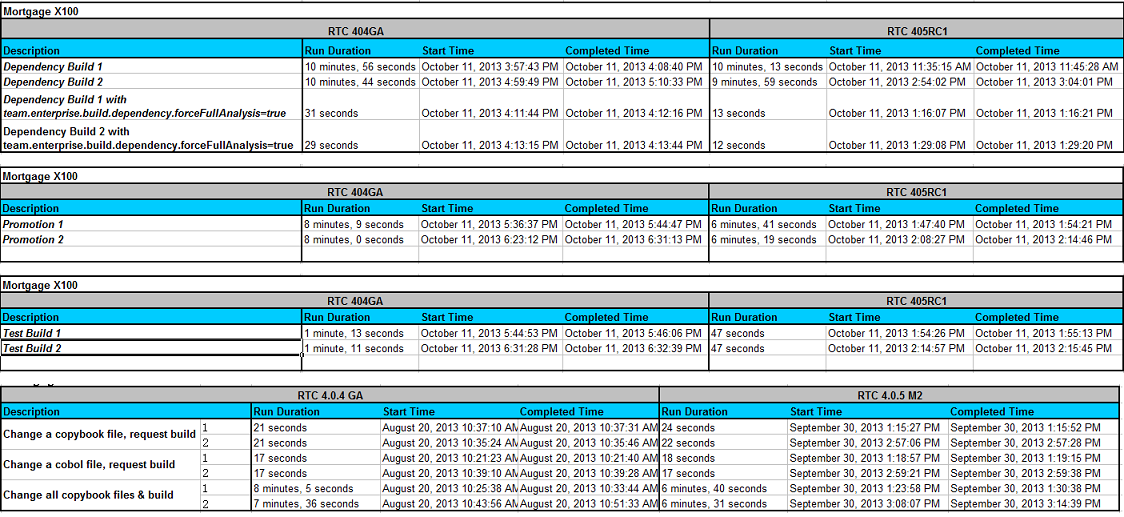

Build Activities


CPU and Memory for RTC server
CPU and Memory for Build Agent
For more information
About the authors
SuHuiQuestions and comments:
- What other performance information would you like to see here?
- Do you have performance scenarios to share?
- Do you have scenarios that are not addressed in documentation?
- Where are you having problems in performance?
- activity_concurrent.png:


| I | Attachment | Action | Size | Date | Who | Comment |
|---|---|---|---|---|---|---|
 png |
activity_build.png | manage | 43.1 K | 2013-10-17 - 11:25 | UnknownUser | |
| png |
activity_build_fullanalysis.png | manage | 23.1 K | 2013-10-17 - 11:26 | UnknownUser | |
| png |
activity_concurrent.png | manage | 81.0 K | 2013-10-18 - 02:27 | UnknownUser | |
| png |
activity_incrementalbuild.png | manage | 334.0 K | 2013-10-17 - 11:28 | UnknownUser | |
| png |
activity_promotion.png | manage | 47.8 K | 2013-10-17 - 11:30 | UnknownUser | |
| png |
run_duration.png | manage | 230.2 K | 2013-10-17 - 10:55 | UnknownUser | |
| png |
run_duration_concurrent.png | manage | 45.8 K | 2013-10-17 - 11:46 | UnknownUser |


 Copyright © by IBM and non-IBM contributing authors. All material on this collaboration platform is the property of the contributing authors.
Contributions are governed by our Terms of Use. Please read the following disclaimer.
Dashboards and work items are no longer publicly available, so some links may be invalid. We now provide similar information through other means. Learn more here.