Jazz Forum Welcome to the Jazz Community Forum Connect and collaborate with IBM Engineering experts and users

What is the intended purpose of the limit by lifecycle query attribute in DNG, and how is it meant to support link-based filtering

In DNG, there is a requirement to filter artifacts based on:

  • "Validated By" links (Typically to test artifacts)
  • "Satisfied by architecture element" links (Typically to affected items or rhapsody links)
  • However, DNG does not provide a direct filter attribute for link types such as validated by or satisfied by architecture element in the standard filter dialog
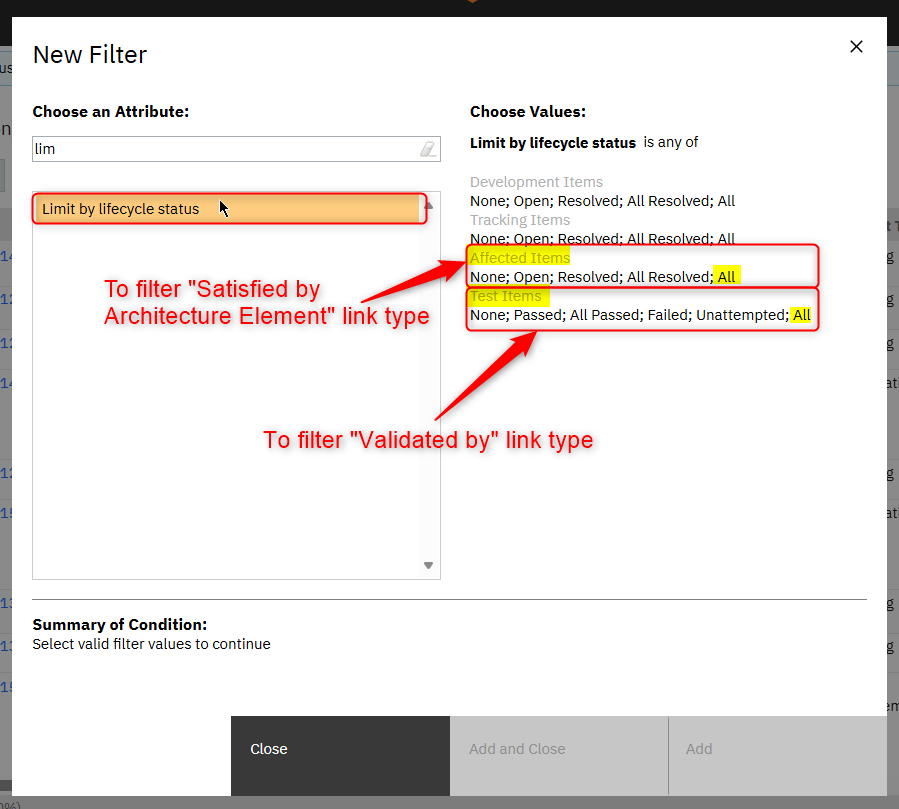
During analysis, the attribute "Limit by lifecycle query" was identified as a possible workaround. When applied:
  • Validated by filtering becomes possible by selecting Test items -> Status = All
  • Satisfied by architecture element filtering becomes possible by selecting affected items -> Status = All
While this workaround produces the expected results, the reasoning behind why this attribute enables such filtering is not well understood.

Questions:
  1. What is the intended design purpose of the "Limit by lifecycle query" attribute in DNG?
  2. Does the usage of "Status = All" a supported and recommended way to filter by the Prescence of the links?
  3. Are there any alternative or cleaner approaches to filter the links "Validated by" or "Satisfied by architecture element"?

0 votes


Accepted answer

Permanent link

The intent of Limit by Lifecycle Status is to allow you to create a view filtered by status at the other end of the link, for example to only show artifacts with Validated By link from a testcase which has a verdict Passed.


Rakshita Patil selected this answer as the correct answer

0 votes

Comments

Okay, in that case can you provide me an instance for the 'Satisfied by architecture element" link type?
As in We have the states "None, Open, Resolved, all resolved and all". But here I'm unaware about what this is exactly means .


One other answer

Permanent link

https://topcasinoangola.com/

0 votes

Your answer

Register or log in to post your answer.

Dashboards and work items are no longer publicly available, so some links may be invalid. We now provide similar information through other means. Learn more here.

Search context
Follow this question

By Email: 

Once you sign in you will be able to subscribe for any updates here.

By RSS:

Answers
Answers and Comments
Question details
× 6,178

Question asked: May 14, 4:03 a.m.

Question was seen: 205 times

Last updated: May 22, 7:49 a.m.

Confirmation Cancel Confirm