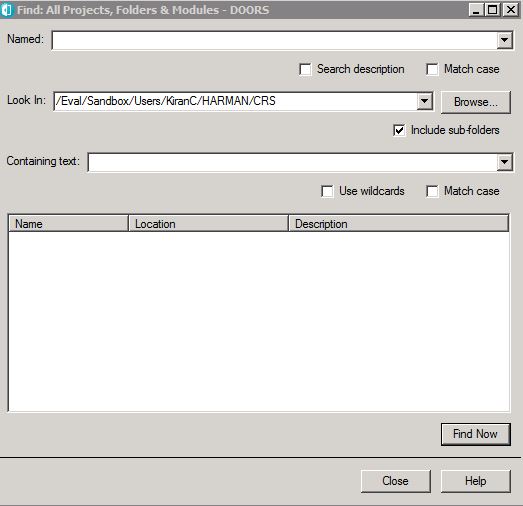
Did any body come across a DXL Perm that replicates the behavior of the DOORS Explorer Window Menu Item " TOOLS > Find " that searches for projects, folders, modules, and specific text in module.
Regards, CAUK77 CAUK77 - Mon Jul 11 02:32:32 EDT 2016 |
Re: DXL Command equivalent to the "Find" in database explorer Does anyone know what the word is when you give someone exactly what they ask for and you know there is about a 99 % chance they won't be happy with what they get.
We will test my theory. What is asked for is:
findReplaceModule_ = current |
Re: DXL Command equivalent to the "Find" in database explorer It took some time for me to understand that I cannot understand what you replied. |
Re: DXL Command equivalent to the "Find" in database explorer CAUK77 - Fri Jul 15 05:44:47 EDT 2016 It took some time for me to understand that I cannot understand what you replied. If you cannot understand his answer, he could not understand your question. And I could not understand your question too, but I do not have any theorie either. |
Re: DXL Command equivalent to the "Find" in database explorer Check the attachment. Its a snapshot. Can I use that "Find" menu in my DXL to search using a wild cards and export the output ! Attachments FIND IN DOORS.JPG |
Re: DXL Command equivalent to the "Find" in database explorer CAUK77 - Fri Jul 15 06:41:39 EDT 2016 Check the attachment. Its a snapshot. Can I use that "Find" menu in my DXL to search using a wild cards and export the output ! You have to create your own function. In another words-- if you want to take this pig to the ball you have to learn to dress her yourself. |
Re: DXL Command equivalent to the "Find" in database explorer CAUK77 - Fri Jul 15 06:41:39 EDT 2016 Check the attachment. Its a snapshot. Can I use that "Find" menu in my DXL to search using a wild cards and export the output ! In the delivery package of doors exists a set of dxl files and a part of this active files is not only an example code, but active code, you know that? If you find the code and the code itself is not encrypted, you can use it.
But it may be simpler to write your own script. Seach for "doors dxl search the database" and you will find some code snippets. |
Re: DXL Command equivalent to the "Find" in database explorer Wolfgang Uhr - Sat Jul 16 02:14:11 EDT 2016 In the delivery package of doors exists a set of dxl files and a part of this active files is not only an example code, but active code, you know that? If you find the code and the code itself is not encrypted, you can use it.
But it may be simpler to write your own script. Seach for "doors dxl search the database" and you will find some code snippets. IBM has changed the rights listed on a dxl script -- therefore you can't automatically assume that you can legally copy and paste from included dxl. |
Re: DXL Command equivalent to the "Find" in database explorer DOORSHAM - Sat Jul 16 05:38:39 EDT 2016 IBM has changed the rights listed on a dxl script -- therefore you can't automatically assume that you can legally copy and paste from included dxl. It makes no sense to produce example scripts with no rights to use them |
Re: DXL Command equivalent to the "Find" in database explorer Wolfgang Uhr - Sat Jul 16 11:35:25 EDT 2016 It makes no sense to produce example scripts with no rights to use them In my country, the law doesn't worry about making sense -- it is there just to punish you for having an opinion and lack of good sense. |
Re: DXL Command equivalent to the "Find" in database explorer DOORSHAM - Sun Jul 17 06:21:04 EDT 2016 In my country, the law doesn't worry about making sense -- it is there just to punish you for having an opinion and lack of good sense. Copyright for an example scripts and even for the productive scripts in that set means, that you are not allowed to copy the complete code and definie it as "your example". But you ever can use code snippets for you own and adapt it to your needs. That ist the reason this files has been made for. Or do you think, that a copyright note in a file which contains If (...) { // ... } else { // ... } disables you to use the if statement? |